Showing posts with label france. Show all posts

August 18, 2010

Discover Paris: Montmartre and its beautiful white Church

The Church of the Sacré-Cœur, perched atop the Butte Montmartre, attracts tourists from around the world. There are no more balls and cabarets of the Belle Époque. Remains the charm of the old Montmartre: its steep streets, its flights of stairs and its beautiful green-roofed houses. On the boulevards, the concert halls are filling up at night while the Pigalle of sex is awaking. A few minutes away, the New Athens district reveals the charms of its romantic quiet streets lined with hotels. A nice transition before walking into bustle of the boulevards.


Start you visit at the Basilica of the Sacré-Cœur. It’s a Roman Catholic Church and minor basilica, dedicated to the Sacred Heart of Jesus. A popular landmark, the basilica is located at the summit of the butte Montmartre, the highest point in the city. The inspiration for the Basilica originated in the wake of the division in French society that arose in the decades following French Revolution, between ultra-Catholics and legitimist royalists on one side, and socialists and radicals on the other. A law of public utility was passed to seize land at the summit of Montmartre for the construction of the basilica. Construction began in 1875 and was completed in 1914, although consecration of the basilica was delayed until after World War I. Inside, a mosaic in the apse, entitled Christ in Majesty, is among the largest in the world. The basilica complex includes a garden for meditation, with a fountain. The top of the dome is open to tourists and affords a spectacular panoramic view of the city of Paris, which is mostly to the south of the basilica.


Have a look at the Church St Pierre de Montmartre, one of the oldest churches of Paris hidden behind a facade of the 18th Century. It is the only remain of the abbey Aux Dames (1147), built on the remains of an alleged former Roman temple, from where could come the 4 columns of marble of the heart of the church. The church is the location at which the vows were taken that led to the founding of the Society of Jesus.


Walk around the Place du Tertre. With its many artists setting up their easels each day for the tourists, the Place du Tertre is a reminder of the time when Montmartre was the Mecca of modern art. At the beginning of the 20th century, many penniless painters including Picasso and Utrillo were living there. Prominent in the square is a cafe, Au Clairon des Chasseurs, which is famous for its reasonably priced local cuisine, and as a bonus, its constant live music which is in the style of Django Reinhardt and the Hot Club of France. L'Espace Salvador Dalí, a museum principally dedicated to the sculpture and drawings of Salvador Dalí, can be found a few steps from Place du Tertre.


Walk down the hill to the Moulin Rouge.  It is a cabaret built in 1889, marked by the red windmill on its roof. The Moulin Rouge is best known as the spiritual birthplace of the modern form of the can-can dance. Originally introduced as a seductive dance by the courtesans who operated from the site, the can-can dance revue evolved into a form of entertainment of its own and led to the introduction of cabarets across Europe. Today the Moulin Rouge is a tourist destination, offering musical dance entertainment for visitors from around the world. Much of the romance of turn-of-the-century France is still present in the club's decor.


Have a look around the Nouvelle Athènes district. The triangle formed by Place Pigalle / Notre-Dame-de-Laurette / Sainte Trinité, built in the 18th century, unveils romantic splendor: English gardens, courtyards and arched passages, neoclassical buildings which were once the residence of a community of artists (Berlioz, Sand, Degas, Chopin, Dumas ...)

End your visit by the Passages Couverts on Boulevard Montmartre. It took a few architectural tricks to build these magnificent glass-roofed passageways and hide the irregularity of the plots. The Passage des Panoramas opened in 1799, followed in 1846 and 1847 by the passages Jouffroy and Verdeau. Traders have kept the tradition of old shops. Some shops are like small museums: books, comics, toys, etc.

How to get there: Montmartre is served by the metro:  line 2 (stations of Anvers, Pigalle and Blanche) and the line 12 (stations of Pigalle, Abbesses, Lamarck - Caulaincourt and Jules Joffrin).

Where to stay: there are many hotels in Paris city centre for all budgets and all tastes.

July 20, 2010

Rouen, City of Art and History

At only an hour and a half from Paris by car and one hour by train, Rouen is known to be the place where St Joan of Arc (Jeanne d’Arc) was burnt. The old city center and museums can be seen in a day trip from Paris.

Once one of the largest and most prosperous cities of Medieval Europe, it was one of the capitals of the Anglo-Norman dynasties, which ruled both England and large parts of modern France from the 11th century to the 15th century. Unfortunately a great deal of Rouen was very badly damaged during the second world war, but extensive reconstruction has taken place to rebuild the medieval old town. Rouen also contains a number of noteworthy monuments including an impressive cathedral - famously painted by Monet on many occasions. 

Places to visit
The Cathedral:  Damaged several times during the centuries, the present building was built in the 12th Century. Last time it was damaged was during the bombing in April 1944 and came close to complete collapse. Happily the cathedral was saved and has undergone major renovations since that time.  Covered in lacy Flamboyant Gothic stonework, Rouen cathedral is dominated by three towers: the Tour Saint-Roman (c.1145); the Tour de Beurre (15th century; 151 m/250 feet) and the Tour Lanterne (1876), which contains a carillon of 56 bells, utilizes 740 tons of iron and bronze, and rises to almost 150m (500 ft). Inside is the tomb of Richard the Lionheart which contains his heart.
From the Cathedral walk to the church of St Joan of Arc via the Rue du Gros Horloge. The old city center of Rouen has beautiful half timber buildings. You will walk under the Great Clock which is housed in a Gothic Belfry with a Renaissance archway. It is spectacular. The astronomical clock and the phases of the moon date from the early 16th century.

The Church of St Joan of Arc is a modern church built on the site where Joan of Arc was burnt in 1431. The large cross stands on the exact spot with the church next to it. Its strangely shaped slate tiled roof is supposed to represent the flames.  It is quite a contrast to the wood and timber buildings on the other side of the square.
Another beautiful gothic church is the Church St.-Maclou which was built in 1432. A block east is the Aître St.-Maclou, a somewhat curiously decorated cemetery dating from the Great Plague in the 14th century. Have a look at the buildings to see carvings evoking death and the mummified cat.
Walking back to the cathedral take the Rue Rollon to have a look at the Palais de Justice (Palace of Justice), the largest civil Gothic building in France. It was constructed during the late middle Ages. It has been restored since the war but certain parts have been deliberately left exposed as a testament to the bombardments the city suffered during its liberation by the allies.

If you have time, visit the Musée des Beaux-Arts (Museum of Art), which features a collection of sculptures and some excellent canvases by Velazquez, Delacroix, Sisley and Monet (including paintings of the Cathedral Notre-Dame in Rouen).

Eating
You can’t leave the city without tasting a crepe (French pancake).  Sharing some delicious crepes with friends and family around a bowl of cider is part of the Normandy experience. Various creperies offer dishes combining traditional galettes (salty pancakes) and crepes with tasty compositions, sometimes quite surprising.

Jeanne d'Arc
I can’t write about Rouen without talking of Jeanne d’Arc (Joan of Arc), a heroine of France and a Saint. Bornt in 1412, she was a peasant girl who led the French army to several important victories during the Hundred Years' War, claiming she had visions from God that told her to recover her homeland from the English domination. She was captured by the Burgundians, sold to the English, tried by an ecclesiastical court, and burned at the stake when she was nineteen years old.  Twenty-five years later, on the initiative of Charles VII, Pope Callixtus III reviewed the decision of the ecclesiastical court, found her innocent, and declared her a martyr. She was beatified in 1909 and canonized in 1920.

How to get there: By car, take the motorway A13 from Paris. It takes about 1h30. By train, several trains depart from the St Lazare Station in Paris for Rouen on a daily basis. Tickets cost around 20 euros and can be purchased at the station immediately beforehand.

July 16, 2010

Strasbourg, one of Europe’s most attractive cities

Having family living in Alsace, I almost feel like I'm from Strasbourg. I love the city, the athmosphere and off course the good food. So I'm trying to come for a visit at least once a year, when I'm not on the roads.

Located close to the border with Germany, Strasbourg is the capital and principal city of the Alsace region in north-eastern France. The historic city centre, the Grande Île ("Grand Island"), was classified a World Heritage site by UNESCO in 1988 thanks to the richness and sheer density of its heritage sites.

The must see are:
The Kammerzell house (16 Place de la Cathedrale): A genuine "jewel in the crown" of Strasbourg’s architecture, this house once provided income for several generations of merchants. During the 15th century, people would sell their goods under the carved stone arches of its ground floor. The intricately carved half-timbered frames decorating the upper floors date from 1589.


The Barrage Vauban (Place Hans-Jean-Arp): The Barrage Vauban (Vauban weir) is a weir erected in the 17th century on the river Ill west of the "Petite France" district. It was constructed from 1686 to 1700 by the French Engineer Jacques Tarade according to plans by Vauban. Several stories high, it houses sculptures in its main level and a panoramically terrace on its roof.


Petite France district: This is the most picturesque district of old Strasbourg. Fishermen, millers and tanners once lived and worked in this part of town where the streets have been built level with the waterways. The magnificent half-timbered houses date from the 16th and 17th centuries. Their sloping roofs open out onto lofts where hides were once dried.


The Cathedrale: it is a Roman Catholic cathedral. Although considerable parts of it are still in Romanesque architecture, it is widely considered to be among the finest examples of high, or late, Gothic architecture. Erwin von Steinbach is credited for major contributions from 1277 to his death in 1318. Described by Victor Hugo as a "gigantic and delicate marvel», the cathedral is visible far across the plains of Alsace. Inside, the slending nave inspires meditation. The monumental organ has an incredible buffet with automatons. Opening hours: Every day from 7 a.m. to 11.20 a.m. and from 12.35 to 7 p.m.


The astronomical clock: it is located inside the Cathedral. Major artifact of the Renaissance, it is the product of a collaboration between artists, mathematicians, watchmakers, sculptors, painters and creators of automatons. The clock dates from 1843. Its main features, besides the automata, are a perpetual calendar (including a computus), an orrery (planetary dial), a display of the real position of the Sun and the Moon, and solar and lunar eclipses. The main attraction is the procession of the life-size figures of Christ and the Apostles which occurs every day at 12:30pm.


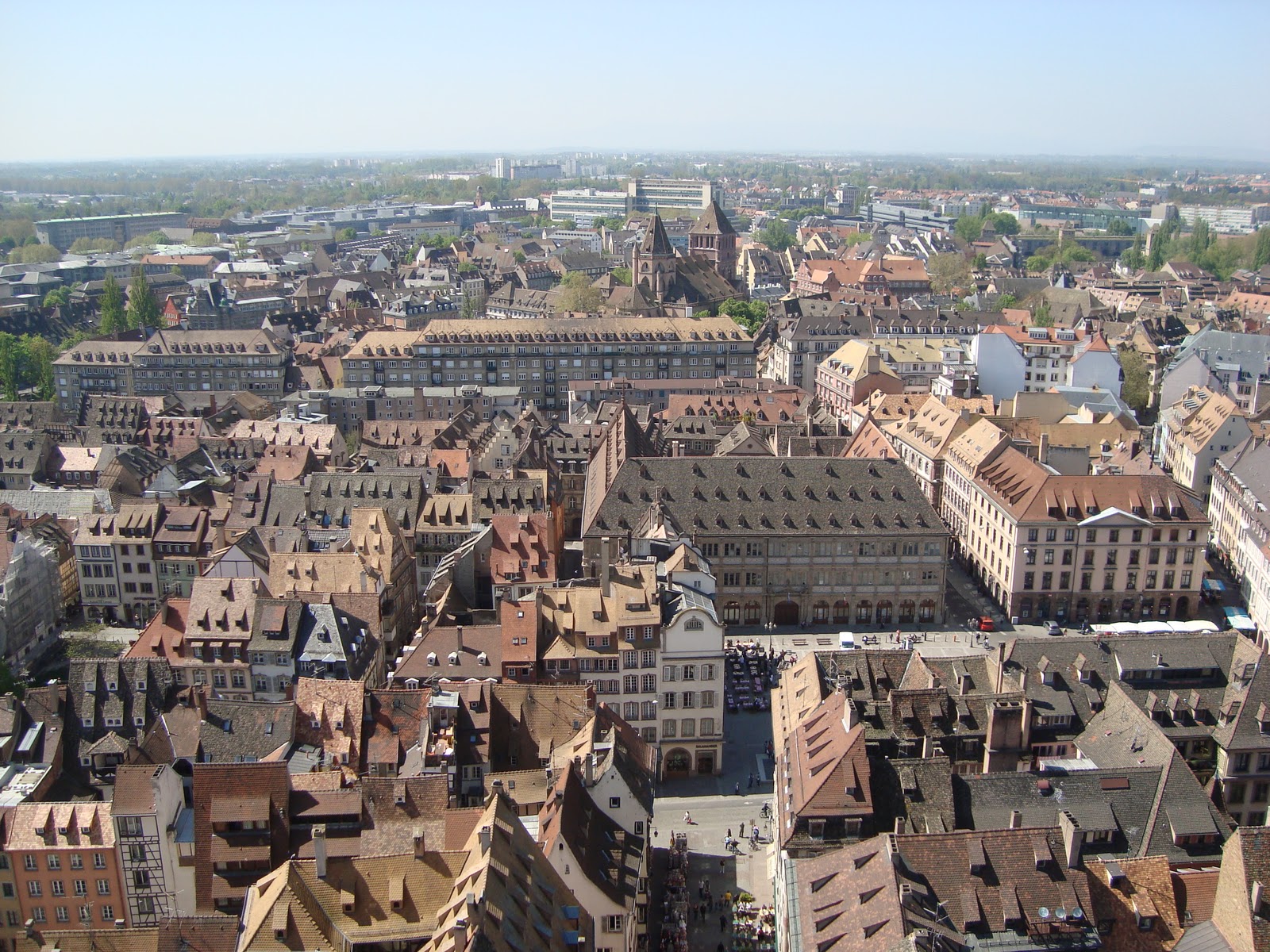
The Cathedral platform: A climb up to the platform (332 steps) is a thrilling experience. The spiral staircase takes you to the very heart of the building, where you can discover some amazing views. The panoramic view from the top of the platform is breathtaking, overlooking the rooftops of Strasbourg and stretching out as far as the Vosges and the Black Forest in Germany when the weather is clear.


The Palais Royan: Former residence of the prince-bishops, it was built from 1732 to 1742. Now it houses three museums: the Decorative Arts Museum, the Fine Arts Museum and the Archaeological Museum.

The European institutions: New York, Geneva and Strasbourg are the only cities in the world which are home to international institutions without being national capitals. The choice of Strasbourg as the European capital following the Second World War is no accident. The city stands as a shining symbol of reconciliation between peoples and of the future of Europe.
Discovering Europe’s institutions is also a great opportunity to admire some marvelous examples of contemporary architecture.


Kronenbourg Brewery: it is a brewery founded in 1664 by Geronimus Hatt in Strasbourg as the Hatt Brewery. The name comes from the area (Cronenbourg) where the brewery relocated in 1850. The company is owned by the Carlsberg Group. The main brand is Kronenbourg 1664, a 5.5% abv pale lager which is the best selling premium lager brand in France. You will follow a picturesque route in the ancient vaulted cellars, before watching a film projection on the history and manufacture of the beer, and then end the visit by tasting different beers. Address :  68 route d'Oberhausbergen 67200 Strasbourg Cronenbourg


How to get there:
- By train: now that the TGV (high speed train) goes to Strasbourg, you can get there only in 2h20 from Paris.
- By air: Strasbourg-Entzheim International Airport is just 10 km from Strasbourg town centre via the motor-way.

Where to eat:
In Strasbourg, cooking is more than just an art of living, it is a vibrant and living culture backed up by centuries of tradition, yet constantly experimenting and innovating, driven on by the talent of the great chefs and the dynamism of the city’s restaurant owners.
Traditional Alsatian specialties such as sauerkraut, baeckeoffe, flambé tart, spaetzle and foie gras can be best enjoyed in the "winstubs", local Alsatian taverns known for their friendly atmosphere. Strasbourg is renowned for its hundreds of restaurants and brasseries offering the latest culinary trends and dishes from all around the world.

When to go:
Strasbourg can be visited all year around. Winters can be really cold with snow but don’t miss the Christmas market every year in December.

July 11, 2010

Summer Festivals in Paris

If you are in Paris for the summer or just spending a few days, enjoy one of the festivals taking place around town.

Paris Plages (20th July- 20th August)
You don’t have the money to go to the beach? Don’t worry, the beach is coming to you! For the 9th year, the banks of the Seine (in the centre of Paris) and the Bassin de la Villette (in the north-east) see the return of 2,500 tonnes of sand, hundreds of deckchairs, pétanque, tai-chi lessons, ballroom dancing lessons and a swimming pool on the Voie Georges Pompidou (4th arrondissement). The activities and concerts at Paris Plages are all free! Roller-blading, BMXing and flatland biking activities are also on offer at the Pelouse de Reuilly (12th arrondissement), near the entrance to the Bois de Vincennes (metro station: Porte Dorée).

Fnac Indetendance Music Festival (23rd July – 14th August)
Every Friday and Saturday from 5 pm, artists such as Tricky, Nada Surf, Arno and Beat Assaillant will be performing in front of the Paris City Hall. More info here (in French)
How to get there? Metro 1 and 11 station Hotel de Ville

Au Clair de Lune cinema (4th-22nd August)
If you like watching movies outside, squares and public gardens across Paris host film screenings. Cinéma au clair de lune (Moonlight cinema) is organized by the Forum des Images and offers around ten outdoor screenings for those that love Paris and cinema. It will feature a film tribute to Eric Rohmer, La Science des rêves (The Science of Sleep) by Michel Gondry, A bout de souffle (Breathless) by Jean-Luc Godard and Two days in Paris by Julie Delpy. Admission is Free
Some recommendations :
- In case of rain, the screenings may be canceled.
- Do not forget a sweater, summer nights can be cool.
To see the program, click Here (in French)

La Villette Open air Cinema (17th July – 20th August)
Another place to watch movies is at La Villette in the North East of Paris. For the 20th edition of the open air cinema , they are showing films on the theme “Beeing 20 years old”
European filmmakers François Truffaut, Jean-Luc Godard, Ken Loach, Maurice Pialat, Leos Carax, Abdellatif Kechiche, Cristian Mungiu; U.S.: Woody Allen, Sofia Coppola, Jim Jarmusch, Asian, Jie Liu, Hong Sang-Soo ... and others, return to blow the 20 candles the favorite rendezvous of the Parisian summer moviegoers.
When: Tuesday to Sunday nights when the night falls. All movies are in original version with subtitles.
Free admission
How to get there? Metro 5 station Porte de Pantin
To see the program, click here (in French)


Paris Jazz Festival (12th June – 1st August)
If you like Jazz, Paris Jazz Festival is the largest summer jazz festival in Paris with the new vocal project by David Linx and Maria Joao, North African jazz and events featuring the musicians Zohar Fresco and Yair Dalal supporting David El Malek. Paris Jazz Festival also features a more “classical” long weekend: Jazz au Vert, a festival which is set to see the likes of Christophe Monniot perform “Vivaldi Universel” and the pianist Enrico Pieranunzi perform his interpretation of Scarlatti.
It’s taking place at the Esplanade Saint Louis, Parc Floral de Paris in the Bois de Vincennes.
How to get there? Metro 1 station Château de Vincennes ; Bus lines: 47 & 112
Admission: €5 / €2.50 reduced rate (concert days only).
For the programm, click here (in English)

Paris Quartier d’Eté festival (14th July – 15th August)
Come and enjoy the 21st Paris Quartier d’Eté festival which is set to take place in several locations across Paris. The programme includes dance, music, theatre and other original artistic forms of expression: ballet from the Grand Théâtre de Genève in the courtyard of the Palais Royal, Feydeau’s play La Dame de chez Maxim, performed by the Compagnie du Théâtre National de Bretagne land the Compagnie Italienne avec Orchestre, Tangier Acrobatic Group directed by a Swiss duo, etc.
Programm: www.quartierdete.com

July 10, 2010

Best Summer Festivals in France

A great way to decompress and get away during the holidays, summer festivals are numerous. Here is a quick overview of events not to miss.

1. Les Francofolies – La Rochelle

Dates: 13 to 17 July 2010
Founded in 1985 at the initiative of Jean-Louis Foulquier, the Francopholies of La Rochelle has an important place in the calendar of the music festivals in France. For evidence, the public's enthusiasm for this event: between 100,000 and 150,000 people are attending each year. The 2010 edition will welcome artists like: Jean Jacques Dutronc, BB Prunes, M.Phoenix, Diam's, Vanesa Paradis, Alain Souchon and Miossec.
For more info (in French), click here


2. Les Vielles Charrues – Carhaix (Bretagne)
Dates: 15 to 19 July 2010
The annual festival lasts four days, Les Vielles Charrues includes artists from Brittany but French and international artists too. Its electrical publicity and friendly spirit make it the biggest festival in France (230,000 entries in 2009). Artists present this year are : Indochine, Muse, Mika, Jamiroquai and Pony Pony Run. But the biggest event will be the live of the group NTM on July 16th.


3. Rock en Seine – Saint Cloud (Ile de France)
Dates: 27 to 29 August 2010
Created in 2003, this young festival has already established itself as a reference for all the lovers of rock, thanks to the representation of international artists. Rock en Seine benefits in addition to an unique setting for all its concerts spread over three stages, in the heart of the Park of Saint Cloud. And this year there will be music for all tastes with the presence of Cypress Hill, Massive Attack, Queen of the Stone Age, The Kooks or Arcade Fire.
For more info click here (in English)


4. Les Rencontres d’Arles – Arles (South of France)
Dates : 3 July to 19 September
Since 1970, Les Rencontres d'Arles is the summer event that brings together international photographic artists and reporters. Thanks to its unique programm, this festival has gained an international dimension. Last year over 70,000 visitors, many from foreign countries, were able to admire the works exhibited in unusual places, such as religious buildings or industrial buildings.
For more info, click here (in English)


5. Festival d’Avignon – Avignon (South of France) 
Dates: 7 to 27 July 2010
Founded in 1947 by Jean Vilar, the Avignon Festival is today one of the most important contemporary performing arts events in the world. Avignon becomes a city-theater, transforming its architectural heritage into various performance venues, majestic or surprising, welcoming tens of thousands of theater-lovers (over 100,000 admissions) of all ages. Its legendary space is the "Cour d'honneur" (main courtyard) of the Popes' Palace, the heart of outdoor performances, before nearly 2,000 spectators, on summer nights in Provence. The Festival successfully brings together a general public and international creation for an original alliance. Avignon is also a state of mind: the city is an open-air forum where festival-goers discuss the shows and share their experiences as spectators.
For more info, click here (in English)

Festivities in Paris for the 14th of July

The 14th of July is the national French day or day of the Bastille.  In Paris, there are many festivities around town.

Free concert – Tuesday 13th July, Place de la Bastille
On July 13, more than 15 exceptional artists are giving a free concert starting at 8:30 pm at place de la Bastille. (Broadcast live on France Ô). The City of Paris in partnership with France Televisions presents the concert of the diversity. This free concert, under the sign of eclecticism, entertainment and sharing, will bring together over fifteen popular artists: Amadou & Mariam Khaled, Chimene Badi, Uncle Ben Soul, Shy'm, Smod, William Balde, Inna Modja, Sheryfa Luna Stanislas Mike Ibrahim, Jean-Roch, Tom Frager, John Mamann, Lord Kossity ...


Militar Parade – Wed 14th July, Champs Elysees
The parade is organized by the Ministry of Defense. It will run from 9:30 to 12:30 on the Avenue des Champs-Elysees. Fifty years after the independence, the troops of fourteen former French colonies in sub-Saharan Africa will lead the traditional parade of 14 July on the Champs-Elysees.

For the first time on the Champs-Elysees, the Special Forces of the Regiment of Parachute Dragoons will be present. To celebrate the centenary of the naval aviation, people will witness an unprecedented parade of planes, and the jump of paratroopers just in front of the official gallery.
If you want to see something, arrive very early to get a good spot. Or… watch it on TV!


Firework – Wed 14th July, Champs de Mars/ Tour Eiffel
The traditional fireworks will be shot on July 14 at 11 pm from the Trocadero gardens on the theme of the colors of the French-speaking community.
To see the fireworks, it’s better to be on the opposite shore to watch the fireworks ( Champs de Mars-Tour Eiffel).
The fireworks & lights show will celebrate the 40th anniversary of the International Organization of the Francophonie, and propose a 30-minute journey to the heart of the French speaking countries.


Around Paris – 13 July
Cities around Paris organize their Firework on the 13th of July with usually a ball following.
•    Versailles: at 9 pm there is a free concert on Place du Marche Notre Dame followed at 11pm by a firework launched in front of the Castle of Versailles. More info here (in French only)
•    Provins: the medieval city is organizing its own firework at 10:30 pm from the main square followed by a concert. It’s a good way to end a day of visit! More info on Provins here