August 24, 2011

Finca Chacula, rural and authentic


When my parents told me they were going to come for a visit in August, I started thinking about where we should go. When I found the website of the Posada Chacula, I knew I had found the perfect place for us. 

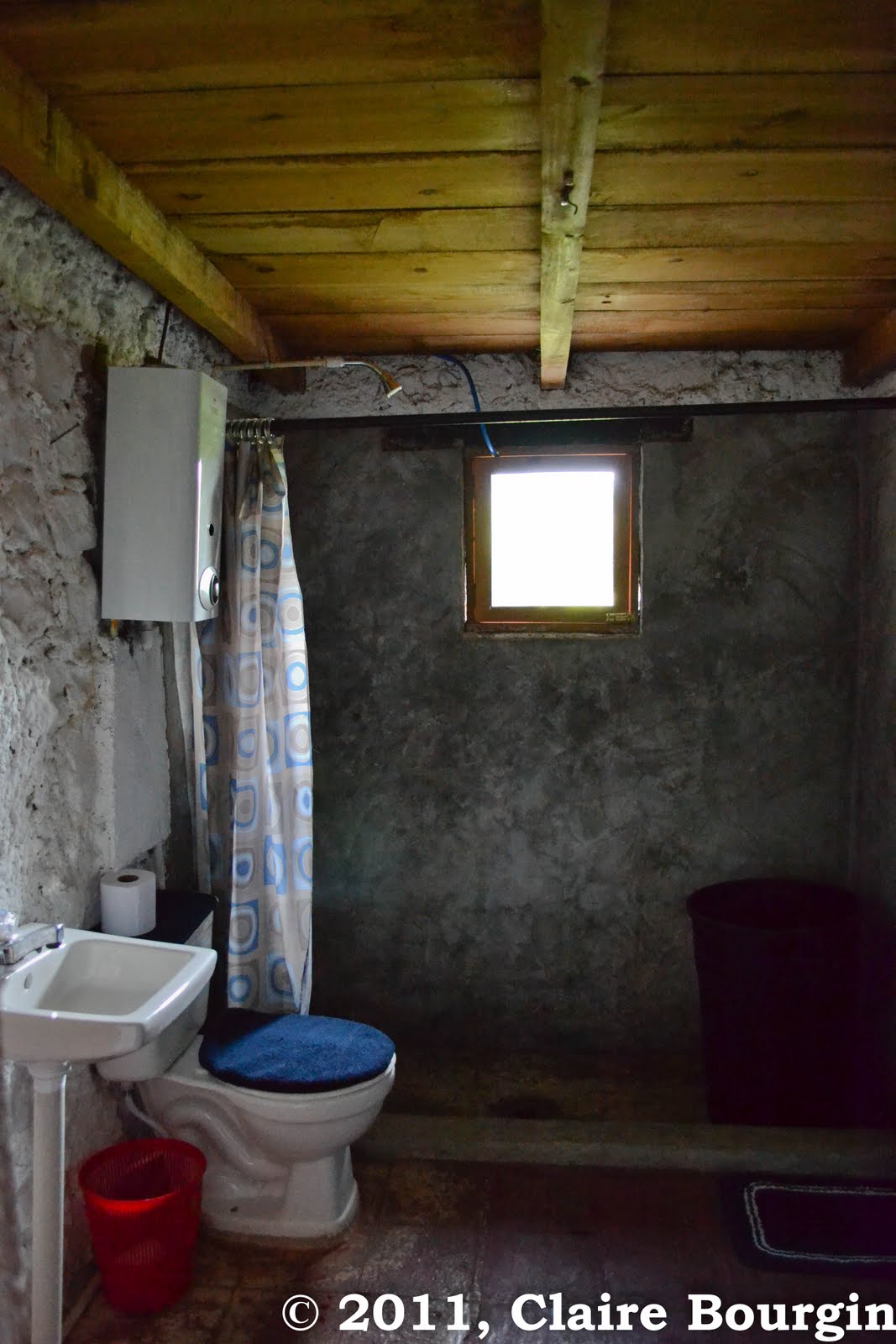
Posada Rural Chacula is a beautiful small hotel located 2.5 hours by car north of Huehuetenango and close to the border with Mexico. The posada is community owned and was opened in March 2010. They have only 3 bedrooms with a maximum occupation of 12 people. We had the house for ourselves for the 4 nights we stayed there so it was like home! There is no electricity and at night they light the petrol lamps which make the atmosphere really special. We were afraid to have to take cold showers but no, it works with gas so it is rustic but too much! 

The night costs around U$20 per person including breakfast. For breakfast you can have bread & marmalade (it was perfect for us!) and/ or eggs & black beans if you want a Guatemalan breakfast.  Lunch & dinner is US$6.00 each and depends on what they have found at the local market which is 1 hour away by car so they can’t go every day. That’s why it’s important to call ahead and not arrive without notice, or you won’t eat! 

A bit of history… People left Guatemala to go to Mexico in 1982 during the civil war. In Mexico, they joined small communities and negotiated with the Guatemalan government their return in 1994. Thanks to a credit given by FONAPAZ (Fondo National para la Paz) they bought the Finca and 210 families came to live.  As they are coming from different parts of the department of Huehuetenango, 5 languages are spoken at Chacula. The community started the ecotourism project in 2010. 

To get there by car, take the road which goes to La Mesilla from Huehuetenango. Arriving at La Democratia, turn right to get to Nenton and follow the road which goes to Gracias a Dios (Mexican border). When you arrive at a T junction, turn right to go to Chacula. You will see a sign in the village saying Posada Chacula, the last 1 km is on a dusty road. You can go too by public transport. 2 buses leave Huehuetenango daily at 4:00 AM & 1:00 PM to go to Chacula and cost 30 Quetzales. 

For more info on the Posada, please check the website here.

In my next post, I’ll talk about the beautiful places to visit nearby!

 Welcome to the Posada!

 One of the room
 The bathroom


 At night, petrol lamps and firework


August 20, 2011

Salto de Chilasco, a hidden treasure

Having a 3 day weekend at the end of July, I took the opportunity to travel and discover an hidden natural treasure of Guatemala: the Salto de Chilasco.

Know as the highest waterfall of Central America with its 133 meters high, the Salto de Chilasco is located in the Reserva Biosfera Sierra de Las Minas, two hours and a half south of Coban (Baja Verapaz)

We rented a car with my friend Lucy and headed to Ram Tzu, an ecological hotel situated close to the Biotopo Del Quetzal, on the road to Coban (km 158). From Guatemala City, it takes around 3 hours drive via El Rancho.

The hotel has 16 beautiful cabanas made in wood and a restaurant made in bamboo.  They have a private natural reserve with horses, a waterfall, an orquidea farm and coffee plantation you can discover by feet. As it was raining during most of our stay we didn't have the opportunity to see it.

On the Sunday we woke up at the sound of the birds. It's much nice than the sound of the Chicken bus which wake me up every morning in Antigua. The rain stopped us to head early to the Salto of Chilasco. But by 11 am the rain had stopped and we decided to take the chance. From Ram Tzu, you have to head south for half an hour than take a left turn on a dusty road in a bad condition. 12 km which took us an hour as we didn't have a 4x4 car. 

We arrived at a small tourism office where we received information about the hike and where to go to start the hike. We paid 30 Quetzales ($4) per person for the entrance fees and we hired a teenager for 30 Quetzales to help carrying the bag as I was with my son Logan. if you need a guide (which is not necessary but is better so not to get lost) you would have to pay the same price. 

As it had rained a lot before our arrival, the first part of the hike had some very muddy and slippery part where it was a bit difficult while carrying Logan. Then it was quite flat until we arrived at the top of the waterfalls. You can hear the sound before you see it appearing through the mist. I have seen many biggest waterfalls as Niaguara falls so off course this waterfall is not that impressive but it's beautiful and the surroundings are unique. The waterfall is located in the rainy forest so all is green and the vegetation is abundant

From the top of the waterfalls the track brings you down to its foot. They arranged well the path so it's easy to go down. If you don't want to go all the way (like us) you can go to the second view point where you can see the whole waterfall and take nice shots. By the time we arrived at the 2nd mirador it was getting late and we had to go back to the car before the night. So we decided against going all the way down and after a snack (a and a bottle of milk for Logan) we headed back. We started the hike at 12 pm and didn't bring any picnic, only a few bars of cereals, so when we get back to the car we were starving! It took us 4 hours in total, walking at a normal space and with a baby. We were all muddy and tired but happy to have seen this hidden treasure not touch yet by massive tourism. 

The Salto of Chilasco is not visited by a lot of tourists and hardly any guidebooks talk about it. This is a pitty for the community who would love to have more income from the tourism. But this is good for the nature as it stays almost untouched and you don't see garbage along the path like everywhere. The location helps to keep massive tourism away and only adventurous travelers will make the effort to visit it and will feel so bless to had the opportunity to visit such a unique place. 

Our room for the night


View from our room


The restaurant all in bambu


Going down to the waterfall


First view of the waterfall


July 16, 2011

Cambodia: 5 Places not to miss in Phnom Penh

Phnom Penh, known as the "Pearl of Asia", is a colouful city full of noise, smells and histotic sites.But most tourists don't stay long enough to experience the city. If you have a day to spare, here are the sites you should not miss.

1. Royal Palace
We started with the vist of the the Royal Palace and the Silver Pagoda located just next to the palace grounds. Once you step inside the compound, passing the high walls, there is silence.

The Royal Palace of Cambodia is the royal abode of the King of Cambodia. The compound was the citadel of King Ponhea Yat (1393-1463) and rebuilt to its present state in 1886, when King Norodom (1834-1904) relocated the royal capital from Oudong to Phnom Penh. The buildings with beautiful towering spires are a great example of classic Khmer architecture found in Cambodia today.

One of the interesting buildings is The Khemarin Palace, also known as Prasat Khemarin or the "Palace of the Khmer King." This is officially the residence of His Majesty, King Norodom Sihamoni.

Vistors can visit the Throne Hall (Preah Tineang Tevea Vinichhay) where coronations and official ceremonies take place, the Temple of the Emerald Buddha (Wat Preah Keo Morakot), Stupas (Chedei), a Royal Dining Hall, the Chan Chhaya Pavilion and a French-style building that was a gift from Napoleon III.

The buildings are surrounded by beautiful & well maintained gardens.


2. Silver Pagoda
On the grounds of the Royal Palace, you should not miss the Silver Pagoda, also known as the Emerald Pagoda to Cambodians.

Originally a wooden structure, the palace was initially constructed in 1892 during the reign of King Norodom, but rebuilt to its present grandeur by King Norodom Sihanouk in 1962. The king spared no effort to make this a true embodiment of brilliant Khmer art. More than 5300 pcs of 1.125 kilo silver tiles are used to cover the floor of the Silver Pagoda, and the silver pieces collectively weigh over six tons.

The staircase leading into the pagoda is marble, and inside, two breathtaking representations of the Buddha hold court. The Emerald Buddha is in fact made of Baccarat crystal, and dates back to the 17th century. A small glass case nearby enshrines a sacred Buddha relic brought from Sri Lanka in 1956 by the Venerable Loeva Em of Wat Lanka. However, the second statue of Buddha is the one that catches the eyes of visitors. Its 90 kilo gold body is studded with 2086 diamonds; the largest of which a 25 karats brilliant piece can be found on the Buddha's crown. Cast in 1904 by King Sisowath at the request of his elder brother King Norodom, it represents Maitreya Buddha, the future Buddha.

There are a total of 1650 items on display at the temple. They include cast gold headdresses made especially for the royal dancers, many solid gold Buddha statues in different forms, gifts from royalties and dignitaries from around the world and a myriad of jewels and precious antiques.

3. Wat Phnom
Wat Phnom is a sanctury which contains the ashes from King Ponhea Yat (1393-1463). This is the symbol of the capital city of Phnom Penh and sets prominently atop an artificial 27 meter hill (or 'Phnom') in the northeastern section of the city. Legend has it that Daun Penh, a wealthy widow, retrieved a large koki tree trunk from the river. She had hoped to use it for a house, but inside a hollow of the trunk, she found four statues of the Buddha. She then ordered for a section of her property to be elevated for a small shrine to be erected to revere the statues. This became a sacred site and people started to settle around the hill; eventually, this became the city it now is. It is here that the city gets its name: ‘Phnom’ means hill in Khmer and ‘Penh’ is of course the name of the lady.


4. Phsar Toul Tum Poung (Russian Market)
This is a very popular market for tourist because you can find all kind of souvenir to bring back home. From genuine antiques to silk scarves and bags, woodcarvings.

5. Tuol Sleng Genocide Museum
The Tuol Sleng Genocide Museum or S21 was used by the Khmer Rouges between 1975 & 1979 to interrogate and torture intellectuals, people who had an education. It is believed that over 17,000 people were imprisoned but only 7 survived. The building was preserved as it was left by the Khmer Rouge and was turned to a museum with photos of the prisoners, cells and instruments of torture.
It's really interested to visit to understand what happened under the Khmer Rouges and how the country suffered because of one man, Pol Pot.

If you're interested to know more about what happened there, you should watch the film S-21: The Khmer Rouge Killing Machine. The film features two Tuol Sleng survivors, Vann Nath and Chum Mey, confronting their former Khmer Rouge captors, including guards, interrogators, a doctor and a photographer. The focus of the film is the difference between the feelings of the survivors, who want to understand what happened at Tuol Sleng to warn future generations, and the former jailers, who cannot escape the horror of the genocide they helped create.
The S21 Prison which was a school before


The Cells


Waterboard displayed at Tuol Sleng. Prisoners' legs were shackled to the bar on the right, their wrists were restrained to the brackets on the left and water was poured over their face using the blue watering can.

June 27, 2011

Destination of the month: Cambodia

There are a few countries I have been but I have never wrote about it so every month I’m going to write a few posts about my travel adventures and put a few pictures about a special country.

This month, I’m starting with Cambodia that I visited in February 2004. A friend of mine is from Cambodia and they flee the country when she was 5. Her dad decided to organize a trip to Cambodia for the friends who helped them when they arrived in France, including my parents. For my friend it was the first time she was going back to Cambodia so it was a very special trip. She asked me to join them so she wouldn’t be the only youth of the group.

We were 11 to travel. It was the first time I was traveling with a group and I only accepted because it was a special occasion. The first part of my trip was not about backpacking and adventures, but more about culture and people.


Our first stop was Phnom Penh, the capital, where we were welcomed by Net’s family.

What strikes you first in Phnom Penh is the traffic. All kind of means of transport are sharing the same streets, from motorbike to cows. You wonder how they arrive all to cohabitate without too many accidents. We quickly understood that the only way not to have an accident is to bump your horn to tell people you’re coming! So all day long you can hear the concert of horns.


After letting our bags at the hotel, we decided to go to explore a bit the neighborhood to find a restaurant.  As soon as we stepped out of the hotel, tuc tuc drivers jumped on us. But we wanted to walk; we quickly understood why they were insisting. Be a pedestrian in Phnom Penh is really dangerous, just to cross the street without being hit is a miracle. We learnt our first lesson!

More about Phnom Penh in my next post.